

The way people search for, consume, and share information has changed radically in recent years. This shift is largely driven by the rapid development of artificial intelligence (AI) and, more specifically, Large Language Models (LLMs) such as ChatGPT, Bard, Gemini, and Claude, among others.
While online visibility used to depend largely on appearing in the top Google results, today users get direct, personalized, and elaborate answers from these AI systems, often without needing to visit the original websites.
This new scenario has given rise to the concept of LLMO, or “Large Language Model Optimization“, which represents a necessary evolution of traditional SEO (Search Engine Optimization). Understanding this concept is key for businesses and content creators to remain visible, relevant, and competitive.

What is LLMO? Definition and origin of the concept
The term LLMO is the acronym for “Large Language Model Optimization“, which in Spanish means “Optimization for Large Language Models”. This concept refers to the set of strategies and techniques specifically designed so that Large Language Models (LLMs) can effectively understand, interpret, use and reference the digital content available on the Internet.
Large Language Modules (LLMs) are AI systems trained on vast amounts of textual data from the internet, documents, books, forums, and websites. Thanks to this training, they can understand human language, generate coherent text, answer complex questions, and participate in conversations much like a person would.
Prominent examples of LLMs include:
- ChatGPT by OpenAI
- Bard (currently Gemini) from Google
- Claude from Anthropic
- CALL of Goal
- Models of companies such as Microsoft or Amazon
These systems are not only used in conversational applications, but are also integrated into search engines, virtual assistants, productivity platforms, and other digital environments.
The LLMO emerges as a response to the need to adapt content, websites, and digital communication strategies to this new reality, in which LLMs are a crucial intermediary between the information available on the web and end users.
In other words, just as traditional SEO seeks to improve search engine rankings, LLMO aims to optimize content so that it is understood, used, and cited by LLMs.

Why is LLMO fundamental in the era of generative AI?
Generative AI is redefining information flows, eliminating traditional intermediaries and providing users with personalized, contextual, and comprehensive answers without the need to navigate between multiple websites.
More than 50% of digital users already interact with AI systems in their daily lives, according to recent studies by Gartner, demonstrating that artificial intelligence has become an everyday channel for searching and interacting with information.
Tools like ChatGPT reached 100 million active users in record time, establishing themselves as primary sources of information and demonstrating that users are increasingly less dependent on traditional search engines.
Platforms like Google integrate generative AI functions into their results through their Search Generative Experience (SGE), which radically transforms the search ecosystem by prioritizing AI-generated answers over conventional organic links.
This paradigm shift creates challenges and opportunities:
- Websites that are not understood or integrated by LLMs risk losing visibility, traffic, and authority.
- Brands that adapt their content according to LLMO principles will be able to position themselves as trusted sources within the responses generated by AI.
- Content attribution and lead generation no longer depend solely on search engine optimization, but also on the ability to be used by language models.
Ultimately, in a context where people ask questions of ChatGPT, Gemini, or virtual assistants before asking Google, not optimizing for LLMs means missing out on key information discovery channels.

Differences between LLMO and SEO: Complementary but distinct
Although they share similar goals, LLMO and SEO have different approaches and methodologies:
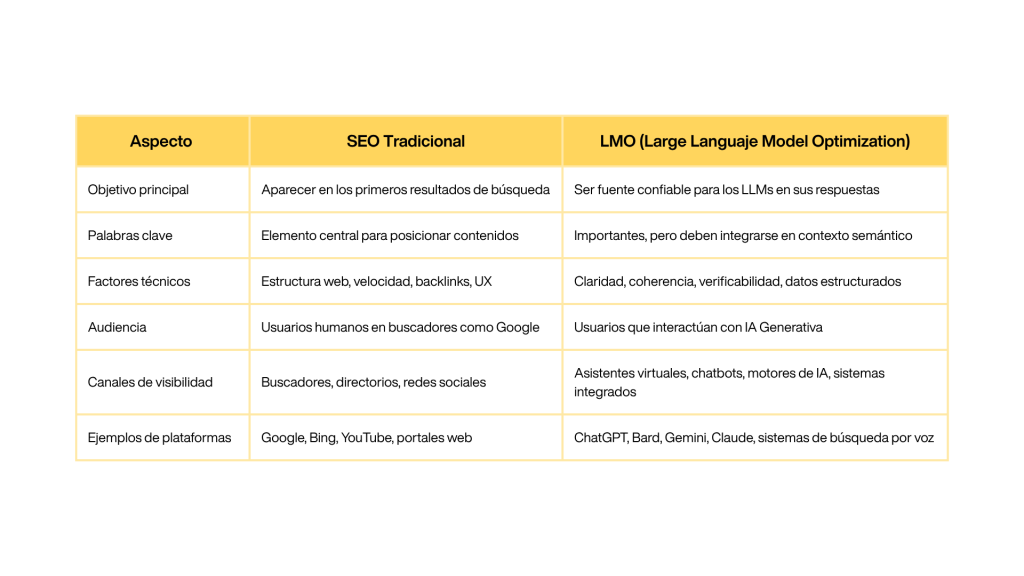
Differences between LLMO and traditional SEO
The LLMO does not replace SEO, but rather complements and expands it into new areas of digital interaction, increasingly focused on AI. While SEO remains fundamental for gaining visibility in traditional search engines such as Google or Bing, LLMO extends that visibility into environments dominated by artificial intelligence, where LLMs play a decisive role in processing, interpreting, and transmitting information to users without them needing to directly visit websites. The convergence of both strategies is key to ensuring a comprehensive, competitive, and sustainable digital presence in a landscape where information seeking is rapidly diversifying.

How does an LLM work and what role does web content play?
Large Language Models (LLMs) are AI systems trained on huge volumes of textual data: web pages, articles, books, public databases, forums, and specialized documents.
Its basic operation involves:
- Massive text processing to learn language patterns, semantic relationships, and grammatical structures.
- Creation of mathematical representations of the meaning of words and phrases (embeddings).
- Generation of responses, summaries, explanations, or original texts from user queries.
Web content plays a fundamental role in this process as it constitutes one of the main training sources for LLMs, especially in their pre-training phase, by providing updated, specialized, and contextual information that the models integrate to improve their accuracy and serves as a direct reference when LLMs generate responses that cite sources or drive traffic to relevant sites.
However, not all content is used equally by LLMs. For a website to be considered, it must:
- Maintain high standards of quality, consistency, and reliability.
- Facilitate understanding through clear structures and verifiable data.
- Apply LLMO techniques that ensure models can effectively identify, process, and integrate information.
In this sense, the LLMO becomes key to ensuring that web content remains relevant in an ecosystem dominated by AI systems.
Without optimization strategies oriented toward LLMs, websites risk becoming invisible in digital environments controlled by artificial intelligence. As LLMs consolidate their role as the main intermediaries between users and information, it becomes essential for content to not only be well-ranked in traditional search engines, but also to be understood, processed, and utilized by generative AI systems.
Effective integration into the responses generated by these models is what will allow companies, brands, and content creators to remain visible, be perceived as reliable sources, and preserve their competitiveness in the new scenario driven by artificial intelligence.

Estrategias de LLMO para optimizar contenidos en la era de la IA
Implementing LLMO requires a comprehensive approach that combines best practices in writing, technical structure, and digital authority. The most relevant strategies are detailed below:
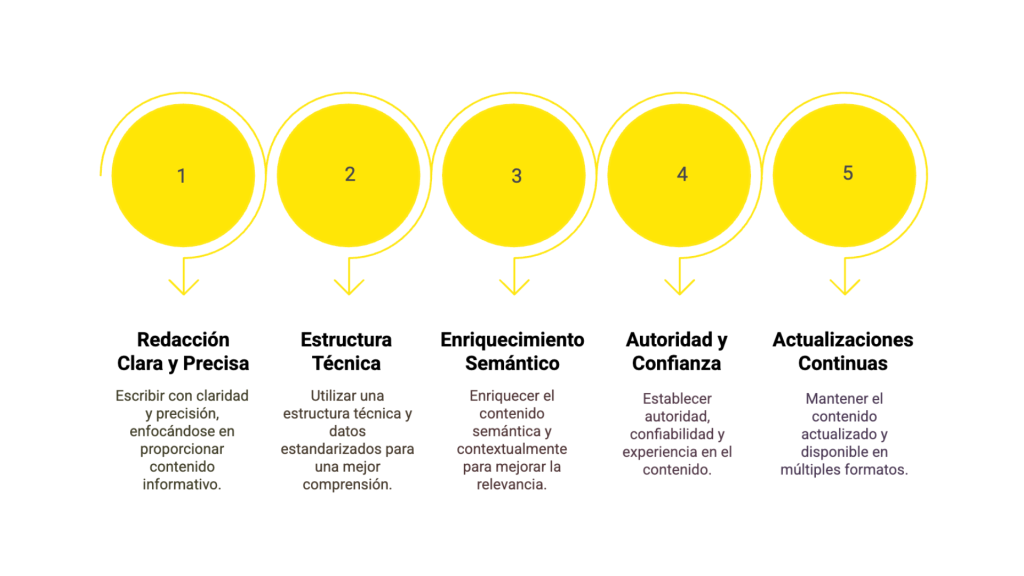
1. Clear, precise writing with an informative purpose
LLMs prioritize content that is written in natural language, avoiding unnecessary and overly complex technical jargon that hinders understanding, that presents well-structured sentences and short paragraphs that facilitate automatic interpretation by the models, that covers topics in a complete and detailed way while anticipating possible user questions or concerns, and that clearly defines concepts, allowing models to extract precise and contextualized meanings.
For example, if you are writing about Local SEO, it is essential to explain what it is, how it works, its importance, and provide practical examples, rather than just making superficial mentions or vague definitions.
2. Technical structure and standardized data
An appropriate technical structure increases the likelihood that LLMs will use the content, which involves the correct and hierarchical use of H1, H2, and H3 headings, the implementation of structured data (Schema.org) that allows AI systems to identify key information such as articles, products, events, or reviews, as well as the use of clean and descriptive URLs that facilitate content indexing and understanding, in addition to a coherent internal navigation without broken links that ensures the entire site structure is easily crawlable and accessible for language models.
3. Semantic and contextual enrichment
LLMs understand not only isolated keywords, but also full semantic context. This means it is essential to integrate synonyms, related terms, and phrases that address user search intent, since language models do not rely solely on exact terms, but instead analyze the overall meaning and coherence of the content.
Furthermore, it is necessary to expand the topics covered by incorporating examples, use cases, comparisons, and updated data that enhance the depth and accuracy of the information. Likewise, the content must be able to answer both informational queries, which aim to explain or educate, and transactional queries, which aim to guide the user toward a specific action or decision.
Only through this enriched and contextualized approach can AI systems effectively integrate and utilize content in their generated responses.
4. Authority, Reliability, and Experience (E-E-A-T)
The quality of the source influences the likelihood of being used by LLMs, as it is essential to publish content authored by verifiable subject matter experts, which adds credibility and trust to the information. Likewise, it is crucial to keep information updated and fact-checked, ensuring that the data is relevant, accurate, and aligned with current industry standards.
It’s also necessary to avoid duplicate or unreliable content practices, as these reduce site authority and negatively impact the perception of AI systems. Finally, improving online reputation through positive reviews, third-party mentions, and backlinks from authoritative sites helps position content as a trusted and valuable source within AI communities.
5. Continuous and multi-format updates
LLMs favor recent information and multi-format content, which implies the need to regularly review and update content periodically, ensuring that data, examples, and references remain current and aligned with digital change.
It is also essential to generate supplementary materials such as infographics, videos, podcasts, or ebooks, which allow information to be consumed in an accessible and engaging way across different formats and channels. Furthermore, maintaining an active presence on social media and specialized communities is crucial, as it reinforces brand authority and increases the opportunities for LLMs to identify, integrate, and utilize the content.
Implementing these strategies ensures that content is visible to both users and AI systems, preserving online relevance and competitiveness.

Implications for businesses and marketing professionals
The rise of Generative AI and LLMs has profound implications for digital marketing strategies, as traditional web traffic may decline if content is not integrated by LLMs.
Brand attribution within AI responses is crucial for maintaining authority and lead generation. Furthermore, SEO, content, and branding campaigns must adapt to the new channels dominated by virtual assistants and chatbots.
Companies that proactively implement LLMO could lead in visibility in AI environments, even displacing larger competitors.
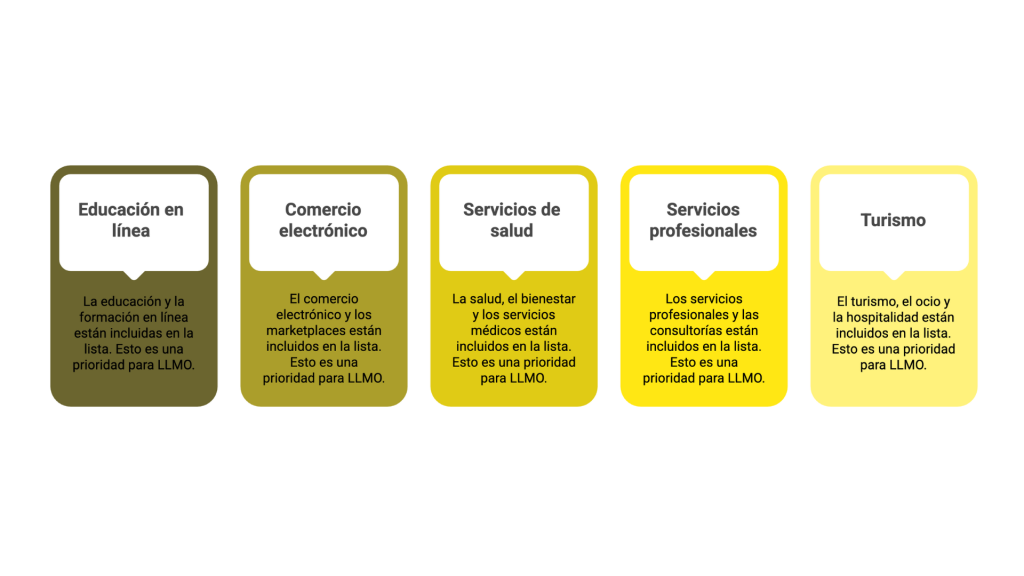
Furthermore, the sectors most affected and therefore a priority for the LLMO include:
- Online education and training.
- E-commerce and marketplaces.
- Health, wellness, and medical services.
- Professional services and consultancies.
- Tourism, leisure, and hospitality.
Experts must be trained in LLM-specific optimization techniques, review website architecture and content standards, monitor visibility across AI channels in addition to traditional search engines, and invest in digital authority, reputation, and the generation of high-quality original content. Adapting in time will prevent companies from becoming invisible in the new digital landscape.

The future of search: From Google to AI assistants
The way users search for and access information is changing significantly. This transformation extends to smart devices, connected cars, and home appliances, which incorporate AI systems capable of answering questions and offering real-time recommendations, expanding the digital ecosystem and the ways users interact with technology.
This shift towards AI-driven search poses significant challenges to traditional SEO strategies, as classic organic search results can be overtaken by AI-generated content. Accurate source attribution becomes essential, as it impacts the reputation and traffic of the original websites. Furthermore, voice search and conversational queries will play a dominant role, requiring content to be semantically optimized for these advanced systems to understand and utilize.
Only through an LLMO strategy can brands and companies be used and cited by LLMs in their responses, maintain their visibility and authority in an environment where AI filters information, and leverage new AI-based discovery channels to effectively reach their audiences.
In this context, adapting to these changes is not just an option, but a critical matter of competitiveness and survival.
Furthermore, this evolution is driving companies to rethink their digital strategies, focusing on offering high-quality, relevant, and reliable content that is not only visible to traditional search engines but can also be integrated and referenced by artificial intelligence systems. Constant innovation and adaptability will be key factors in maintaining a strong and significant presence in the future of digital marketing.
Adapting to the LLMO is key to digital visibility and relevance
The current ecosystem no longer relies exclusively on traditional search engines. LLMs, generative AI, and intelligent assistants are redefining how users access information, make decisions, and discover brands.
The LLMO is not an option, it is a strategic necessity for:
- Ensure that content is understood, used, and cited by AI systems.
- Maintain visibility, authority, and traffic generation in a changing search environment.
- Leverage the opportunities offered by technological transformation to lead in your sector.
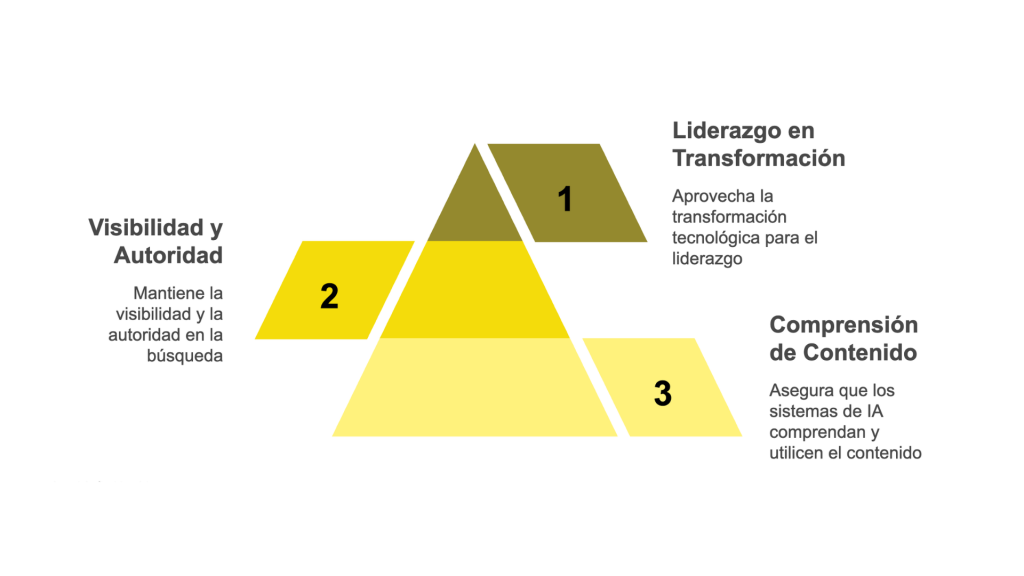
Companies, media outlets, and professionals who act in a timely manner, implementing LLMO strategies, will be better prepared to compete and stand out in the digital environment.
Do you want to protect and enhance your business’s visibility in the age of AI?
Schedule a consultation today specializing in LLMO, SEO, and optimization for Generative AI systems. Discover how to adapt your strategy, keep your content visible, and ensure your brand is part of the responses generated by the most advanced AI models.
The future of search is already here.
Your digital presence depends on acting now.