

Google continues to demonstrate that its search engine is far from static. In its constant effort to improve the user experience, it has officially launched a new feature called “ask a follow-up question”. This tool not only changes the way we interact with the results, but also opens the door to a conversational search experience, intuitive and adapted to each user’s context.
With this update, Google reaffirms its commitment to deeply integrating artificial intelligence into its search engine, marking the beginning of a new era where search becomes an intelligent and personalized dialogue.
What is the “ask a follow-up question” feature?
Google has incorporated this feature as part of its vision for conversational search. Although initially available only on mobile devices, it is now also active on desktop, allowing more users to use it directly from the web version of the Google search engine.
This tool appears just below certain featured results (such as rich snippets or generative summaries). Clicking the button takes the user to an interface that allows them to:
- Select a suggested question related to your original search.
- Write a new follow-up question in free form.
The key is that Google maintains the context of the previous search, preventing the user from repeating terms. This creates a smoother experience, similar to a conversation with a virtual assistant.
For example, if a user searches for what is content marketing? and then clicks ask a follow-up question, they can type: how can I apply it in my B2B company?. Google understands that they are referring to the same topic, and generates a contextualized answer without needing to redo the search from scratch.
This feature reflects how Google is integrating artificial intelligence and conversational search into the traditional search experience, paving the way for wider adoption of AI Mode and Search Generative Experience.

Why is Google doing this?
Google search is evolving to increasingly resemble a conversation with an intelligent assistant, rather than just a list of links. This feature responds to three key trends:
- The advancement of generative artificial intelligence.
- The evolution towards conversational interfaces.
- The behavior of the modern user, who expects speed, context, and accuracy.
Google wants its results to be more natural, personalized, and useful, without forcing the user to repeat terms or start from scratch every time they need to clarify or expand on information.
Furthermore, it is aligned with the development of the Search Generative Experience, which promotes AI-generated responses in real time and encourages the use of natural language in interactions.
How it works: step-by-step experience
This feature is designed to improve how users interact with Google search results, making the process more fluid, intuitive, and adapted to current conversational behavior. Here’s how this functionality works in practice:
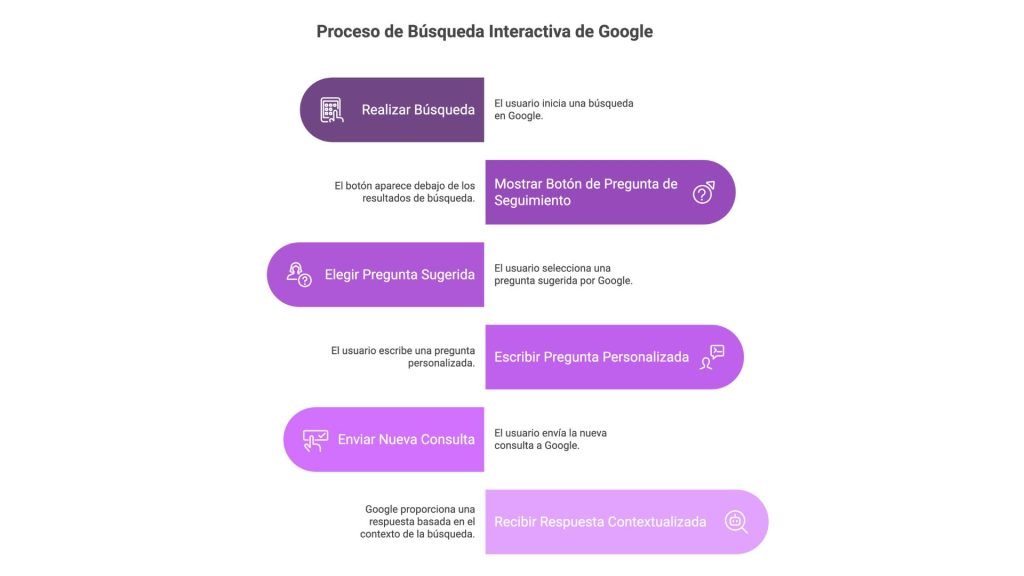
- You perform a search on the Google search engine, either from a desktop or mobile device. This can be an informational, commercial, or educational query, such as: “benefits of email marketing”.
- Just below a featured result (such as a rich snippet or an AI-generated response), the “ask a follow-up question” button may appear. This button isn’t displayed in all results, but it’s becoming increasingly common in topics where the user might need more context or depth.
- Clicking this button opens an interface that allows you to do two things:
Choose a question suggested by Google, based on what other users have searched for or what the AI considers relevant as a follow-up.
Write a related question freely, allowing you to personalize the conversation and adapt the search to specific needs without having to repeat terms. - Once the new query is submitted, Google generates a contextualized response; that is, it understands that the new question is related to the previous search and responds while maintaining that conversational thread. This interaction feels closer to a chat with a virtual assistant than a traditional search based on independent keywords.

This flow is part of a broader trend toward conversational search, driven by the rise of tools like ChatGPT, Bard, and Bing’s AI-powered search engine. Google is integrating these capabilities directly into its main search engine to stay at the forefront of user experience.
Furthermore, this type of navigation reinforces Google’s vision with its new AI Mode and Search Generative Experience, where it’s not just about delivering links, but about offering helpful and personalized answers, generated by artificial intelligence, which evolve as the user continues to ask questions.
In terms of user experience, this functionality:
- Reduces the need to formulate multiple separate searches.
- Improves user retention within the Google ecosystem.
- Increases the expectation of receiving clear, direct, and in-depth content.
Therefore, if your content is not prepared to respond in a structured, precise, and natural language way, it will likely be left out of the conversational flow that Google is starting to prioritize.
Implications for SEO strategy
This functionality has important implications for any business that relies on search engine optimization.
1. The content should be more conversational
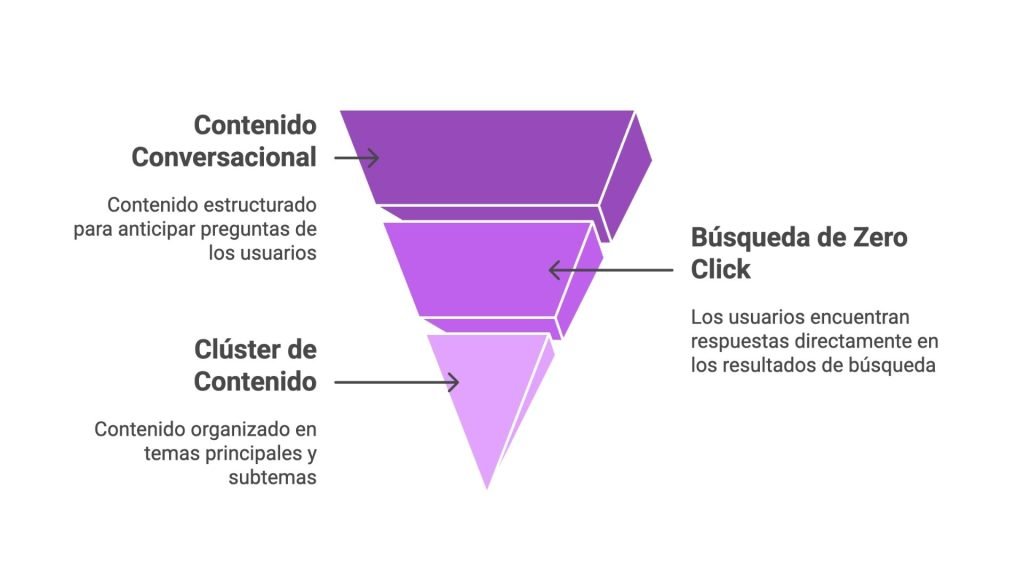
It is no longer enough to include the main keywords. The content should be structured to anticipate the questions the user might ask next, facilitating the continuous discovery of information.
In other words, it is necessary to generate answers at multiple levels of depth, not just answer the basics.
Example:
- Instead of just answering “What is SEO?“, also create content that answers:
- What are the benefits of SEO?
- What tools are used?
- How do I start a strategy?
- How long does it take to see results?
This makes you a rich and useful source within the new results format.
2. Tendency towards “zero click”: the user browses less
Google is increasingly responding directly within the search engine itself, which increases the number of “zero click search” cases, that is, searches where the user does not click on any website.
This button can intensify that trend.
What can you do?
- Make sure your content is optimized to appear in featured snippets.
- Include clear summaries, well-structured headings, and lists that Google can display directly.
3. Greater value of cluster type content
An effective strategy for positioning yourself in this new feature is to use the content cluster model, where you create a pillar page (main topic) and secondary articles (related subtopics).
This approach makes it easier for Google to understand the semantic relationship between your content and improves your ranking for follow-up questions.

Example: How would you apply this to a content strategy?
To understand how to leverage the “ask a follow-up question” feature within an effective content strategy, let’s imagine a practical case applied to a B2B company.
Suppose you have a company that offers ERP software solutions for SMEs. The goal is to position yourself as an authority on the subject within the Google search engine, not only for general queries, but also for conversational searches with specific intent.
Your strategy can be structured under a cluster content model, with a pillar page and several satellite pieces of content that address related subtopics. For example:
Pillar page:
What is an ERP and how does it work?
This page should answer the main question in a comprehensive, in-depth, and clear manner, including examples, benefits, application sectors, and basic technical elements.
Supporting Content:
- What are the benefits of an ERP for manufacturing companies?
- What are the common mistakes when implementing an ERP?
- ERP vs CRM: Which does your company need?
- How to calculate the ROI of an ERP?
- What are the best ERPs for SMEs?
- Cloud ERP vs on-premises ERP: Which is better?
These secondary articles allow you to cover different search intents that may arise from the original query and position yourself for multiple follow-up questions.
With this content architecture, if a user searches on Google for something like:
“what is an ERP?”, and then uses the “ask a follow-up question” function to type: “what is the best ERP for logistics?”, your website could appear thanks to the semantic connection and depth of the related content you already have published.

Furthermore, if your pages are well-structured, with hierarchical headings, lists, direct replies, and rich snippets, you increase the likelihood that Google will display your content as part of its generative summaries, boosting your visibility even without the user clicking.
This approach is especially powerful in the context of the new AI Mode and the evolution towards more contextual, AI-driven search. Google not only indexes words, but also understands thematic relationships, conversation patterns, and content depth.
Therefore, a content strategy should not only answer a specific query but also anticipate future ones. The key is to build a connected content ecosystem that can accompany the user throughout their search flow, from an initial question to an informed decision.

Who does this affect?
This feature is not just a visual tweak to the Google search engine; it represents a shift in how information is consumed and who manages to capture the user’s attention.
This change directly impacts:
- Content creators, who will need to adapt their writing to a more conversational style focused on user intent.
- Digital marketing teams, who will have to rethink how they structure their content strategy to appear in AI-generated results.
- SEO agencies, who must update their practices to rank content in an environment where context and depth matter more than just keywords.
- Businesses that rely on organic traffic, as this type of feature can reduce clicks and centralize results within the search engine.
- Local businesses, which compete for visibility in rich results and now also in conversational searches.
And indirectly, it affects anyone who wants to appear on Google, since the new search model tests the quality, structure, and relevance of digital content.

What we know so far
- AI mode in Google Search was officially announced on May 20, 2025, during the Google I/O conference, marking a significant transformation in how users interact with the search engine.
- It is available to all users in the United States through the Google app and the Chrome browser.
- Google has not made an official announcement detailing features or definitive release dates for other countries.
- It aligns with the trends of AI and Generative Search Experience, incorporating the Gemini 2.5 Pro model to offer conversational and multimodal responses.
- It does not replace, but complements, traditional search, offering a more dynamic and conversational experience.
- It may be the start of a transition to more conversational search. all of them, although it is still in the testing phase and its international expansion is yet to be confirmed.
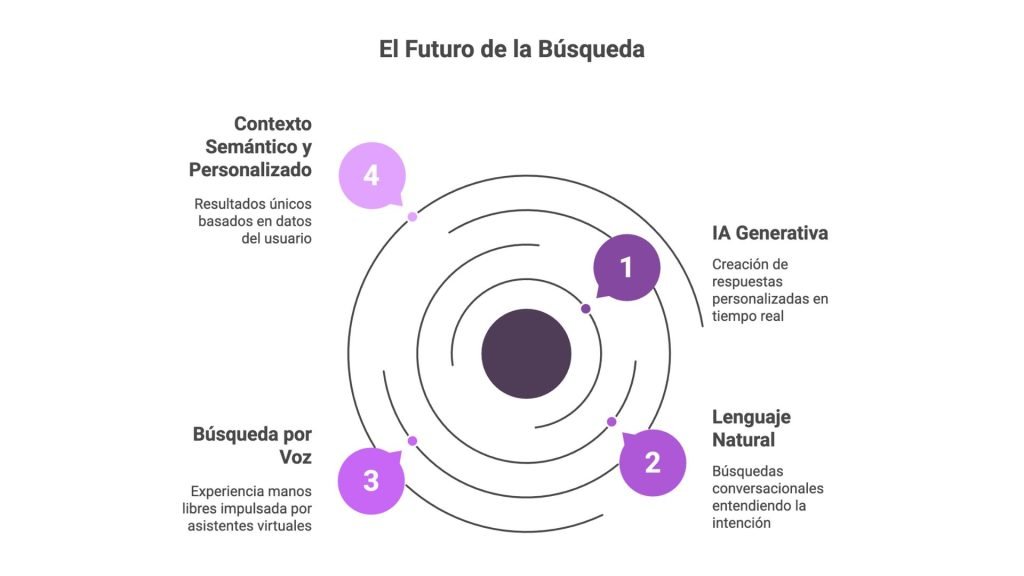
What can we expect in the future?
The evolution of Google’s search engine points towards an increasingly deeper integration of advanced technologies that will transform the search experience and digital marketing:
- Generative AI: Answers and results are created and personalized in real time, based on advanced models like Gemini 2.5 Pro, enabling more natural and accurate interactions.
- Natural Language: Searches are becoming increasingly conversational, understanding the intent and context behind users’ questions.
- Voice Search: The growing popularity of virtual assistants and mobile devices drives a hands-free experience that demands fast, contextualized answers.
- Personalized Semantic Context: Google will use behavioral, location, and preference data to deliver unique results tailored to each user.

For specialists, this implies a fundamental change in SEO strategies. It will no longer be enough to optimize for isolated keywords; it will be crucial to design content and experiences that respond to complete conversations, with a focus on intent, relevance, and real value for the user.
Although it may seem like a minor update at first glance, features like AI mode in Google Search foreshadow a profound change in how people interact with the search engine. Google no longer simply delivers links: now it converses, interprets, suggests, and responds directly to the user’s needs. This new paradigm compels us, as specialists, to also transform how we create and optimize content, adapting to an era where search is more human, dynamic, and conversational.
The future of search is now, and we want you to be a part of it!
The future of SEO and user experience is changing rapidly, and only those who adapt will be able to stand out in a world dominated by artificial intelligence and conversational search. At Keycode, we offer you the strategy, tools, and expertise to make your brand not only visible but also a leader in this new digital age. Don’t wait for your competition to get ahead.
Contact us today and together we’ll design an innovative strategy that will take your online presence to new heights.
Written by Barbara Cabrera/Marketing Analyst