

The question isn’t just which costs less, but which generates more value over time. Consumer attention is divided among screens, stimuli, and platforms; understanding how each type of advertising works is key to making an informed choice.
Meanwhile, traditional advertising still has power in specific segments: older adults, people who are not digitally connected, rural consumers, or mass audiences such as those who watch broadcast television.
So, how do you determine which path to take?
The most profitable investment isn’t always the cheapest, but rather the one that generates the highest return on investment (ROI). That’s where digital advertising has a clear advantage. With a smaller budget, you can run A/B tests, measure results in real time, and scale what works. In contrast, traditional media requires larger investments and offers less room for adjustment.
Furthermore, digital advertising doesn’t exclude small or local brands. Even with limited budgets, businesses like coffee shops, medical offices, or clothing stores can achieve significant results if they segment their audience effectively.

What is traditional advertising and digital advertising, and what channels does it include?
Traditional advertising refers to all forms of promotion disseminated through offline media. Although its use has declined in many sectors, it remains relevant in high-impact campaigns or where physical presence carries significant symbolic weight.

Traditional Advertising
Traditional advertising refers to all forms of promotion disseminated through offline media. Although its use has declined in many sectors, it remains relevant in high-impact campaigns or where physical presence carries significant symbolic weight.
Main traditional advertising channels:
- Television (TV): The quintessential mass medium. Ideal for national campaigns or mass-market consumer products. Its high cost and lack of segmentation make it impractical for small businesses.
- Radio: Despite being more economical than TV, it has similar limitations. It is useful for local or promotional campaigns with a limited duration.
- Newspapers and magazines: Although declining, they are still used by brands seeking a specific type of audience (for example, luxury or business magazines).
- Billboards and posters (OOH): Guaranteed visibility, but no way to know if it generated sales. Ideal for branding, but not so much for conversion.
- Direct mail (flyers, leaflets, etc.): Still used in commercial areas or trade shows. It’s difficult to track their effectiveness, but they can be useful as a visual reminder.
These forms of advertising operate in a unidirectional manner: the brand sends a message, but receives no response or immediate feedback. Furthermore, segmentation is limited, based on time of day, region, or print sections, rather than on individual interests or behavior.

Digital Advertising
Digital advertising is all advertising done online, in multiple formats and platforms. Its main advantage is that it allows for real-time segmentation, measurement, and optimization, making it the ideal tool for businesses of all sizes.
Main digital advertising channels:
- Google Ads (SEM): Your ads appear precisely when someone is searching for your products or services. Highly effective for generating leads and sales in later stages of the funnel.
- Social Media Advertising: Platforms like Facebook, Instagram, TikTok, LinkedIn, and YouTube allow you to display ads based on age, location, interests, and behavior. Perfect for generating awareness, engagement, or conversions.
- Display Ads and Banners: Appear on websites, blogs, or mobile apps. Useful for remarketing or reinforcing brand presence.
- Email Marketing: A direct and personalized tool. Through segmentation and automation, you can send relevant messages at the right time.
Video advertising: On YouTube or streaming platforms. Increases brand recall and allows you to tell stories creatively.
Marketplace advertising: Such as Amazon, MercadoLibre, or Facebook Marketplace. Ideal for consumer products.
Additionally, content marketing and SEO are also part of non-paid digital advertising, helping brands achieve organic search engine rankings, although their results tend to take longer to materialize.

Key features and evolution of traditional and digital advertising
For decades, traditional advertising was the only way to connect brands with consumers. Its power lay in interruption: capturing attention during a TV broadcast, a song on the radio, or a newspaper article. Brands fought for seconds of visibility on high-traffic channels with little way of knowing whether that impact would translate into sales.
Traditional Advertising
For decades, traditional advertising was the only way to connect brands with consumers. Its power lay in interruption: capturing attention during a TV broadcast, a song on the radio, or a newspaper article. Brands fought for seconds of visibility on high-traffic channels with little way of knowing whether that impact would translate into sales.
Key features:
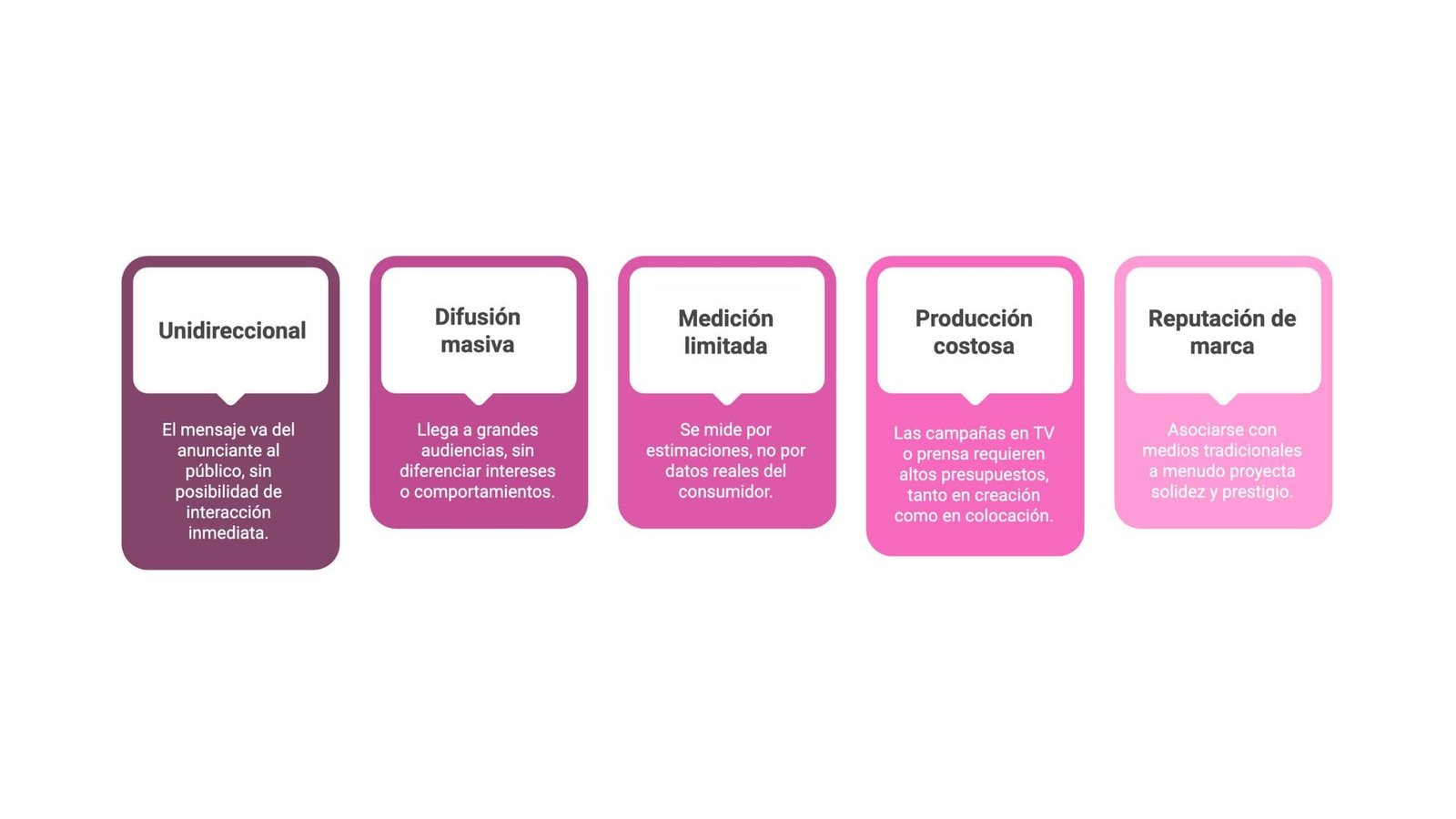
- One-way: The message goes from the advertiser to the public, without the possibility of immediate interaction.
- Mass reach: It reaches large audiences, without differentiating interests or behaviors.
- Limited measurement: It is measured by estimates (TV ratings, newspaper circulation), not by real consumer data.
- Expensive production: TV or print campaigns require high budgets, both for creation and placement.
- Brand reputation: Partnering with traditional media often projects solidity and prestige.
With digitization, these media lost relevance. Today’s consumer demands relevance, personalization, and speed, which has left traditional media at a disadvantage compared to digital formats.
Digital Advertising
Digital advertising has completely changed the landscape. Unlike traditional advertising, it doesn’t interrupt, but rather accompanies the user as they browse. Its evolution has been rapid, thanks to data and artificial intelligence.
Key features:
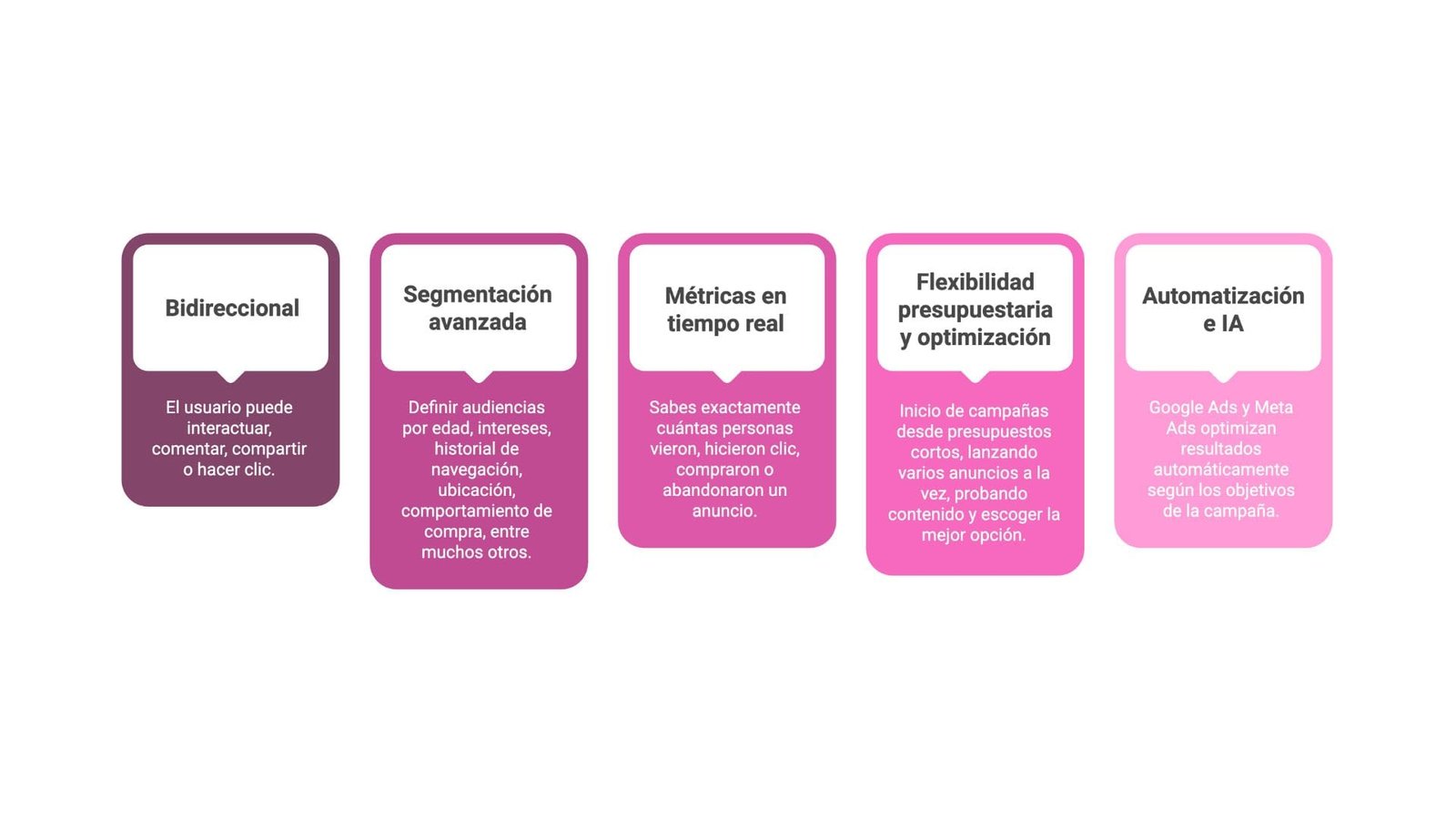
- Two-way communication: Users can interact, comment, share, or click.
- Advanced targeting: You can define audiences by age, interests, browsing history, location, purchasing behavior, and much more.
- Real-time metrics: You know exactly how many people viewed, clicked, purchased, or abandoned an ad.
- Budget flexibility: You can start campaigns with a daily budget of just a few pesos. Ideal for SMEs. Testing and optimization: You can launch multiple ads at once, test headlines, images, or calls to action, and keep what works best. Automation and AI: Platforms like Google Ads and Meta Ads automatically optimize results based on campaign objectives.
In just one decade, digital advertising has gone from being a novelty to becoming the preferred channel for businesses large and small to generate leads, sales, and brand positioning.

Comparison: Reach, segmentation, and effectiveness in both models
This is where the real difference in strategic value and return on investment (ROI) becomes apparent. While both models have their merits, their capabilities and limitations are clear:
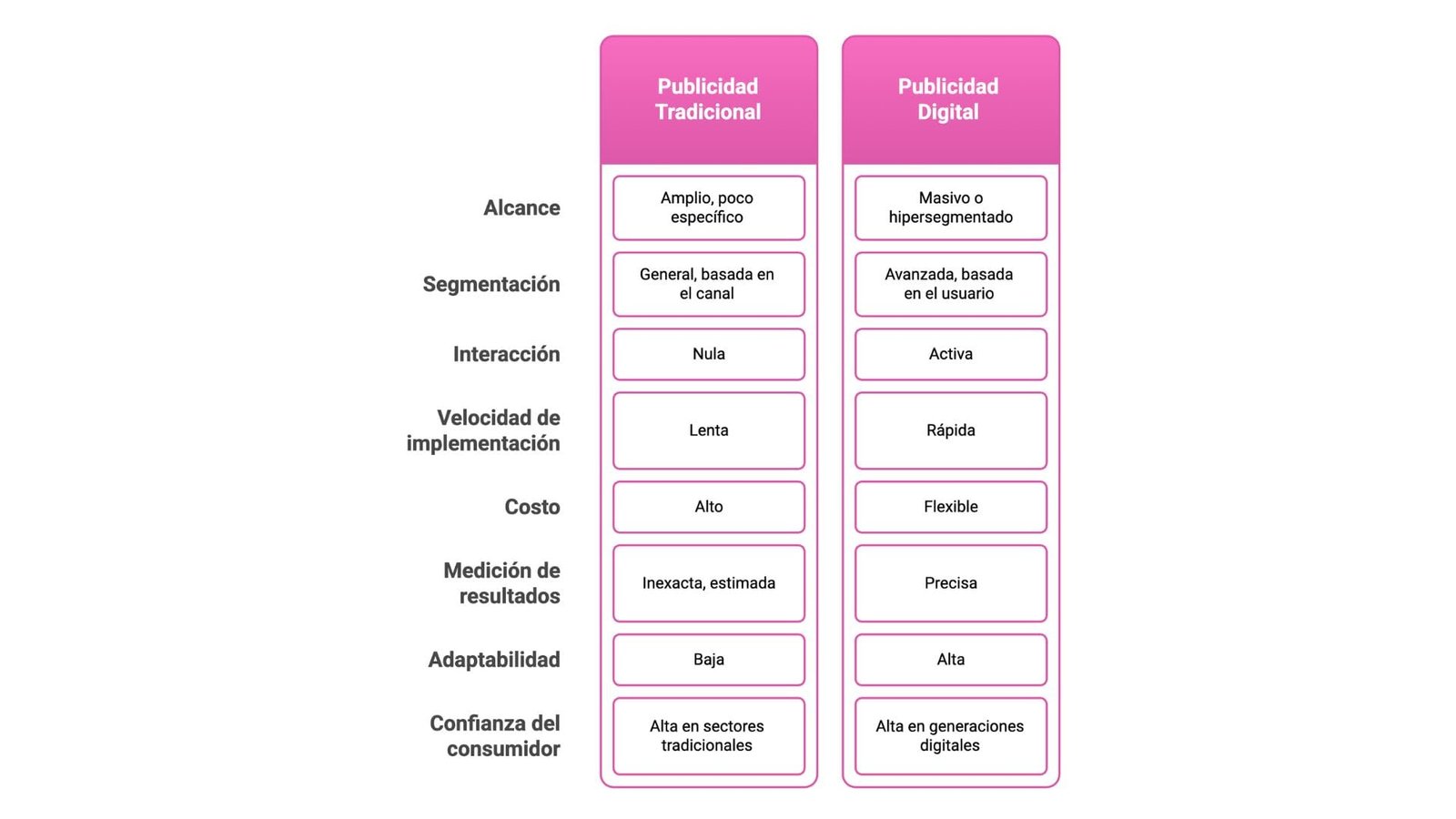
Digital advertising far surpasses traditional advertising in terms of personalization, measurement, and effectiveness, making it the ideal choice for businesses that need measurable results. However, traditional advertising still plays an important role in large-scale, institutional, or branding campaigns.

How is ROI measured in digital and traditional advertising?
One of the most important differences between these two models is the ability to measure real results. While traditional advertising relies on estimates, digital advertising allows businesses to measure return on investment (ROI) directly, in detail, and in real time.

ROI Measurement in Traditional Advertising
The ROI in traditional media such as TV, radio, or print newspapers is difficult to calculate accurately, as it is often based on assumptions and general audience studies. For example, if you place an ad in a newspaper, you may know its circulation (how many copies are printed), but not how many people actually saw your ad or whether they took any action afterward.
Methods such as the following are used:
- Post-campaign surveys
- Increased sales (without knowing which channel to attribute them to)
- Printed coupons with unique codes (to track responses)
- Brand recall studies
This implies a high degree of uncertainty, especially for businesses that require immediate results or have limited budgets.

Measuring ROI in Digital Advertising
Digital advertising, in contrast, allows for precise tracking of the entire user journey: from seeing an ad on social media to making a purchase, leaving their data, or requesting information.
It is measured by:
- CTR (Click-Through Rate): percentage of clicks per view.
- CPC (Cost Per Click) and CPM (Cost Per Thousand Impressions).
- Conversions: number of sales, completed forms, registrations, etc.
- CAC (Customer Acquisition Cost).
- ROAS (Return on Ad Spend): how many pesos/dollars you earned for every peso/dollar invested.
- Real-time tracking through tools such as Google Analytics, Meta Ads Manager, Tag Manager, etc.
Furthermore, thanks to automation, you can pause ads that aren’t working, reinvest in the ones that are, and make strategic decisions on the fly.
If your business needs clear data on the impact of its investment, digital advertising not only gives you complete ROI visibility, but also allows you to continuously optimize to improve your results.

Use cases: In which industries does each type work best?
Choosing between digital and traditional advertising also depends on the type of business, the target audience, and the purpose of the campaign. Although digital leads in efficiency and segmentation, there are sectors where traditional advertising still has strategic strength.

Traditional advertising is ideal for sectors with large or non-digital audiences
- Fast-Moving Consumer Goods (FMCG) Industry: Brands like Coca-Cola and Bimbo still use television to reinforce their presence and mass recognition.
- Government and Institutional Campaigns: They send messages that must reach all ages and sectors of the population, including those who are not connected to the internet.
- Mass Events or Sporting Events: Radio and TV remain relevant for promoting events with high national impact.
- Rural Media or Older Audiences: If the target audience is not digital, radio or print media remain effective.

Digital advertising is ideal for businesses seeking conversion, segmentation, and scalability
- E-commerce and online stores: They need measurable campaigns, with remarketing, targeted offers, and high product turnover. Facebook Ads, Google Ads, and SEM campaigns are ideal here.
- Startups and local businesses: social media advertising campaigns allow you to build community, drive traffic to your website, and acquire qualified leads without large budgets.
- Online education, courses, and webinars: Campaigns segmented by interests, age, country, and academic background allow you to reach the perfect audience.
- Professional services and consulting: SEO, Google Ads, or unpaid advertising on social media help position valuable content that builds authority and attracts clients.
- Tourism and hospitality: Remarketing and geographic targeting allow you to display ads for hotels, flights or vacation packages at the right time.
Some industries opt for hybrid strategies. For example, a university might advertise on local radio to build brand awareness and, at the same time, run lead generation campaigns on Google Ads. Or a restaurant chain might launch a branding campaign on TV while running geo-targeted promotions on Facebook.

How to combine digital and traditional advertising in a hybrid strategy
Although digital advertising dominates today due to its precision, targeting, and ROI, that doesn’t mean we should discard traditional channels. In fact, many brands are achieving outstanding results by merging both into a well-coordinated hybrid strategy.
The goal of a hybrid strategy is to leverage the massive reach and credibility of traditional media, along with the flexibility, personalization, and precise measurement offered by digital. This combination allows campaigns to have greater depth, consistency, and reach, impacting the customer at different points in the decision-making process.
For example, imagine an industrial equipment rental company that wants to generate more qualified leads. It can launch a campaign on radio or billboards in key industrial areas to build brand awareness, while simultaneously running a campaign on Google Ads focused on keywords such as “aerial lift rental” or “forklift rental in Monterrey.” In addition, it can implement social media retargeting for users who visited its website but did not complete the contact form.
Another example is a sustainable e-commerce brand that invests in a feature article in a lifestyle magazine or participates in a live event with its own booth, while simultaneously running a dynamic remarketing strategy on Facebook and Instagram to showcase products previously viewed by users. This allows the brand to create an emotional connection offline and ultimately drive conversions online.
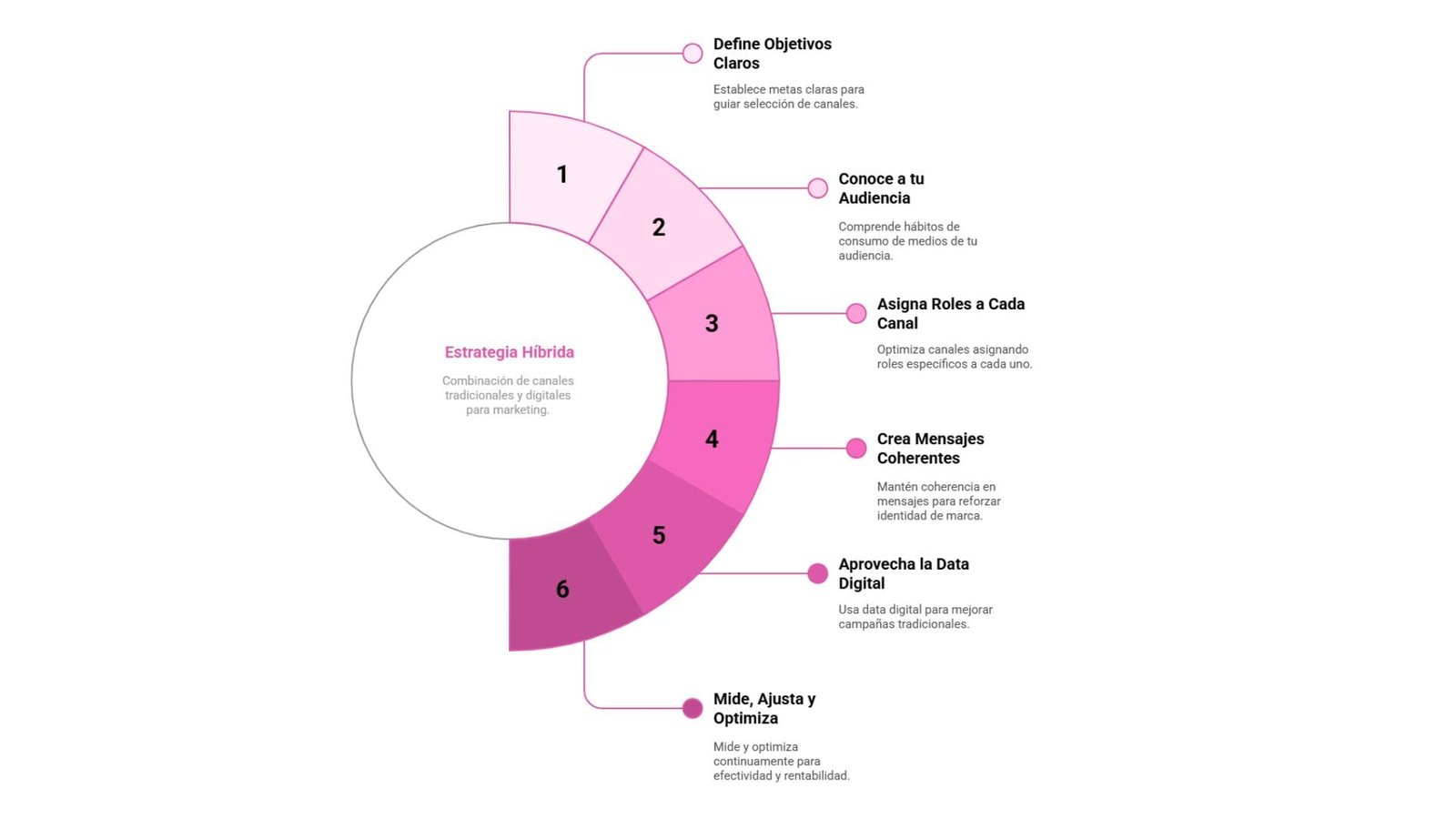
How to build an effective hybrid strategy?
- Define clear objectives: Are you looking for brand recognition, lead generation, immediate sales, or long-term positioning?
- Know your audience: Where do they consume content? What media do they use most? Do they trust social media, radio, or specialized portals?
- Assign roles to each channel: Use TV or radio to generate emotional impact and awareness; Use digital for lead generation, tracking, remarketing, and conversion. Create consistent messaging: Storytelling and brand values must remain consistent across both environments. Leverage digital data to inform traditional methods: For example, if you notice that your audience in Meta Ads responds better to a certain message, use it in your radio spot as well. Measure, adjust, and optimize: Digital allows you to test quickly, adjust budgets, and scale what works. This can even help you make better decisions about future offline campaigns.
The important thing is not choosing one channel or another in isolation, but designing a strategy that reflects the actual behavior of your current customer. Today more than ever, users combine media: they see a story on Instagram, hear an ad on Spotify, and then Google the product. Your brand must be present at every key moment.

Choose the ideal channel for your business with expert advice
Not all strategies work equally well for every sector. While a social media campaign might be perfect for a local restaurant, a B2B company could benefit more from well-targeted SEM campaigns, complemented by in-person events or trade press coverage.
Therefore, the first step to improving your advertising investment is to understand your business, your objectives, and your ideal customer.
At Keycode, we combine market analysis, technology, and creativity to help you choose and optimize the channels that truly work for you. Whether you’re just starting out on social media, looking to scale Google campaigns, or evaluating how to integrate offline and online efforts, our team can help you design a profitable and measurable strategy.
Are you ready to discover what kind of advertising truly drives your business? We help you turn your advertising investment into real results. Schedule a session with our experts and find the ideal combination for your industry.