


Have you wondered how artificial intelligence is completely transforming digital marketing and SEO? Discover the strategies leading companies are using to multiply their results.
The AI revolution that is redefining digital marketing
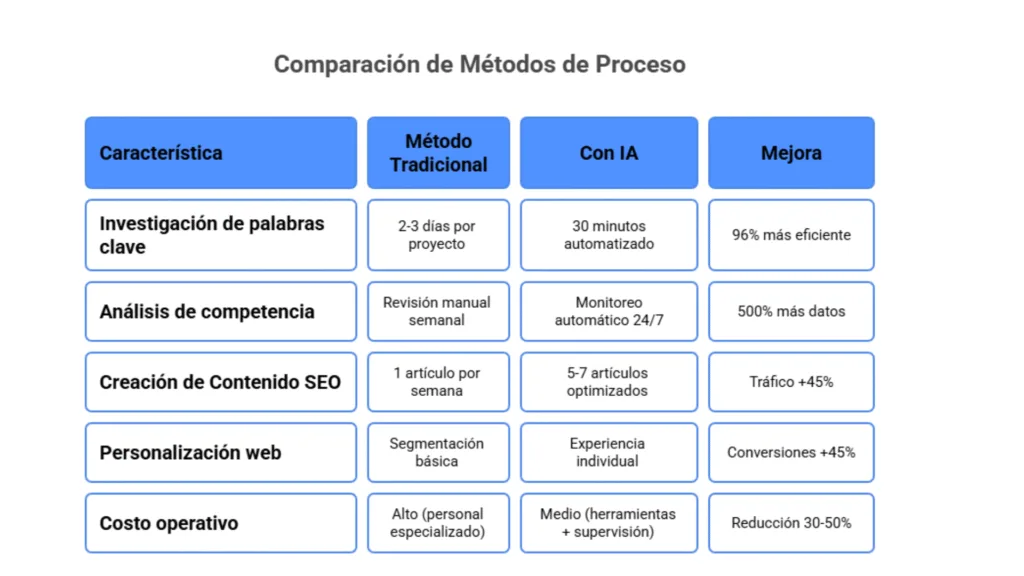
61% of companies are already using artificial intelligence in their digital marketing, and the numbers are striking: businesses that implement AI in their SEO strategy experience an average 37% increase in organic traffic within the first 6 months.
If your company is looking to improve its online presence and increase conversions in 2025, artificial intelligence is no longer optional it is essential. From predictive algorithms that identify the perfect content to automation tools that optimize campaigns in real time, AI is redefining SEO and digital marketing.
What is artificial intelligence in SEO and digital marketing?
Artificial intelligence applied to marketing refers to technologies capable of analyzing patterns, making automated decisions, and performing tasks that traditionally required specialized human intervention.
AI Applications in SEO
- Analysis of millions of web pages to understand search intent
- Automated keyword research with higher precision
- Content optimization based on updated ranking factors
- Trend prediction and emerging topics
Implementation of AI in digital marketing
- Dynamic personalization of ads and content
- Intelligent automation of email marketing campaigns
- Predictive customer behavior analytics
- Advanced audience segmentation
The 4 Biggest AI Opportunities in Digital Marketing
AI personalization allows you to create unique experiences for each user, processing thousands of interactions simultaneously.
1. Personalización a escala: el santo grial del marketing
Personalization through AI allows for the creation of unique experiences for each user, processing thousands of interactions simultaneously.
Success story: Netflix uses AI algorithms to personalize recommendations, resulting in 80% of the content consumed coming from these automated suggestions.
Practical applications for your business:
- Personalized email marketing with specific products for each customer
- Dynamic website content that adapts to each visitor
- Programmatic advertising with ultra-specific targeting
2. Intelligent Automation: Beyond Repetitive Tasks
AI automation not only executes processes, but also learns and optimizes continuously.
Intelligent automation tools:
- Conversational chatbots that solve complex queries 24/7
- Automated social media management with posting at optimal times
- Predictive email marketing that determines the perfect sending time
3. Predictive analytics: anticipating customer decisions
What value would there be in knowing which customers are considering canceling their subscription before they actually do?
Real example: Spotify implemented predictive AI to identify users with a high probability of canceling, sending them personalized offers that reduced customer churn by 30%.
4. Real-time content optimization
AI algorithms can test thousands of content variations simultaneously, automatically identifying the best-performing versions.
Measurable results:
- 25–40% increase in conversion rates
- 50% reduction in customer acquisition cost
- Automatic improvement in SEO rankings
The 4 main risks of AI in marketing
The risk: Automating so much that we lose the authentic emotional connection with our customers.
1. Loss of the human factor in communication
The risk: Automating so much that we lose the authentic emotional connection with our customers.
Warning signs:
- Content that sounds mechanical or impersonal
- Automatic responses that generate frustration
- Loss of creativity and originality in campaigns
Mitigation strategy: Use AI as an intelligent assistant, while always maintaining human oversight in important strategic decisions.
2. Data privacy and ethical considerations
The challenge: AI requires large volumes of personal data to function effectively.
Legal and reputational risks:
- Fines for GDPR non-compliance (up to €20 million)
- Loss of customer trust due to data mismanagement
- Legal problems due to discriminatory algorithmic biases
3. Excessive technological dependence
The risk: What happens when AI systems fail or make incorrect decisions?
Documented cases:
- Uncontrolled Google Ads campaigns that burned budgets within hours
- AI-generated content with incorrect information that damaged brand reputation
- Algorithms that amplified existing biases in the data
4. Hidden implementation costs
Beyond the price of the tools:
- Specialized team training
- Complex integration with existing systems
- Ongoing maintenance and updates
- External consulting for successful implementation
Recommended AI tools by category
AI Tools for SEO
- Semrush (AI-powered): Automated competitive analysis and keyword research
- Jasper AI: AI-powered content generation optimized for SEO and conversions
- Surfer SEO: Real-time content optimization based on SERP analysis
- MarketMuse: AI-driven content strategy and planning
AI Tools for Digital Marketing
- HubSpot Marketing Hub: Full automation with predictive lead scoring
- Mailchimp (AI features): Email marketing with engagement prediction
- Facebook Ads Manager (Advantage+): Automated optimization of advertising campaigns
- Dynamic Yield: Real-time website personalization
Your AI Implementation Plan: 90 Days to Success
Phase 1 – days 1-30: analysis and preparation
Week 1-2: Full Audit
- Evaluate what data you currently have available
- Identify the most repetitive and time-consuming processes
- Define a realistic budget for implementation
Week 3-4: Tool Selection
- Start with a specific tool (e.g., chatbots or automated email)
- Try free versions before investing
- Train the team in AI fundamentals
Phase 2 – days 31-60: controlled implementation
Gradual implementation:
- Set up your first automation with clear metrics
- Establish specific and measurable KPIs
- Perform weekly results monitoring
Phase 3 – Days 61-90: Optimization and scaling
Analysis and expansion:
- Evaluate what worked and what needs adjusting
- Expand successful strategies to other areas of marketing
- Plan more significant investments based on proven ROI
Best practices: the balance between AI and the human factor
Recommended Strategies
Gradual implementation: Don’t overhaul everything at once
Maintain human control: AI suggests, humans decide
Measure results constantly: Without data, there is no optimization
Continuous training: AI evolves, your team must evolve with it
Transparency with customers: Inform users when you use AI in interactions
Mistakes you should avoid
Blindly following all AI recommendations
Ignoring data privacy regulations
Expecting immediate, miraculous results
Completely removing the human touch
Implementing AI without understanding how it works
Your competitive advantage with AI
Artificial intelligence in digital marketing is not a passing trend: it is the natural evolution that defines the competitive future. Companies that adopt AI intelligently, ethically, and strategically will gain significant advantages in:
- Operational efficiency and cost reduction
- Personalization at scale and improved customer experience
- Real-time data-driven decision-making
- SEO positioning and online visibility
The question is not whether you should implement AI in your marketing strategy, but how to do it in the most effective way for your specific business.