


Ecommerce is no longer an option but a necessity for thousands of businesses looking to remain competitive, profitable, and scalable. Online stores offer an unprecedented opportunity to reach more customers, automate processes, and improve the shopping experience. However, simply being “online” is not enough. Building an online store requires strategy, technology, design, content, trust, and a user-centered approach.

What is e-commerce and why is it booming?
E-commerce (or electronic commerce) is the buying and selling of products or services through digital means, usually via an online store. This model has grown exponentially thanks to the increased use of smartphones, digital banking, marketplaces, and the digital transformation of businesses.
In markets like Mexico, e-commerce penetration has broken records in recent years, with double-digit annual growth. This has been driven by:
- The change in post-pandemic shopping habits
- Greater confidence in digital payments
- Logistical advances that allow for faster deliveries
- The arrival of tools like Shopify and WooCommerce that make it easier to create a store without being a programmer
This boom has also created a highly competitive environment. Attractive products are no longer enough; now, technology, automation, optimized content, and a great user experience are essential.

Ecommerce platforms: Which is the best option for your online store?
One of the most decisive steps in launching or scaling an ecommerce project is choosing the right online sales platform. This decision directly impacts design, user experience, scalability, costs, security, and operational efficiency. Not all platforms are the same, and not all of them suit every type of business.
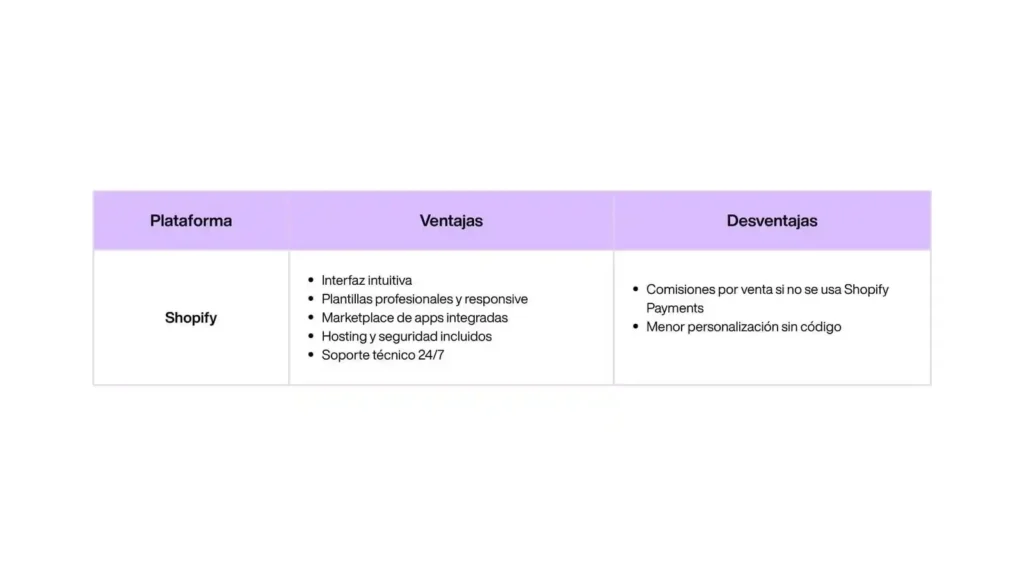
Shopify
Shopify is an all-in-one platform focused on ease of use and scalability. It allows you to launch an online store quickly, without requiring technical knowledge. Ideal for SMEs looking for modern design, simplicity, and growth without technical complications.
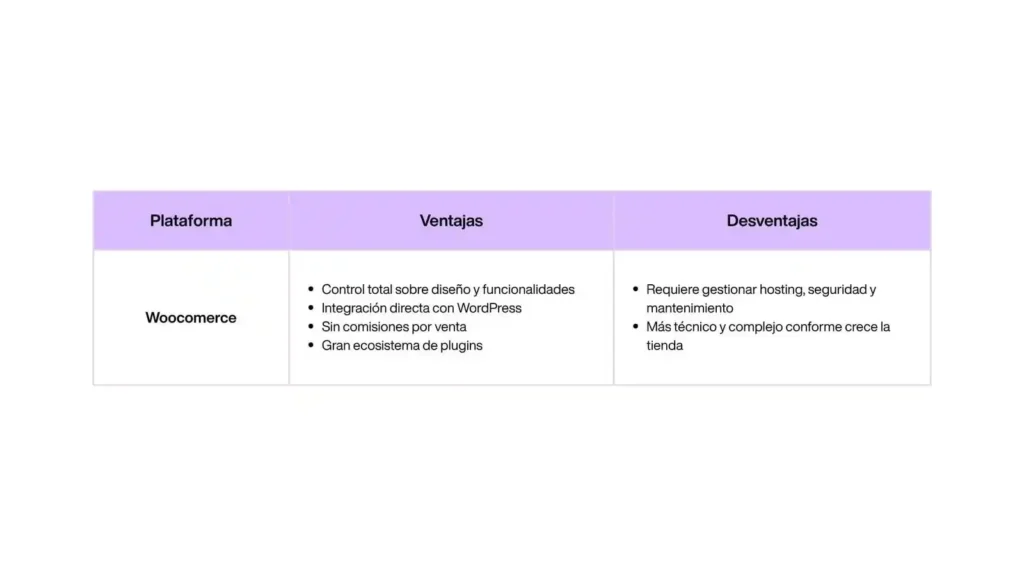
WooCommerce
WooCommerce is an e-commerce plugin for WordPress. Ideal for those who already have a site on this platform or need a fully customizable store. Ideal for businesses with a technical team or those that value customization freedom.
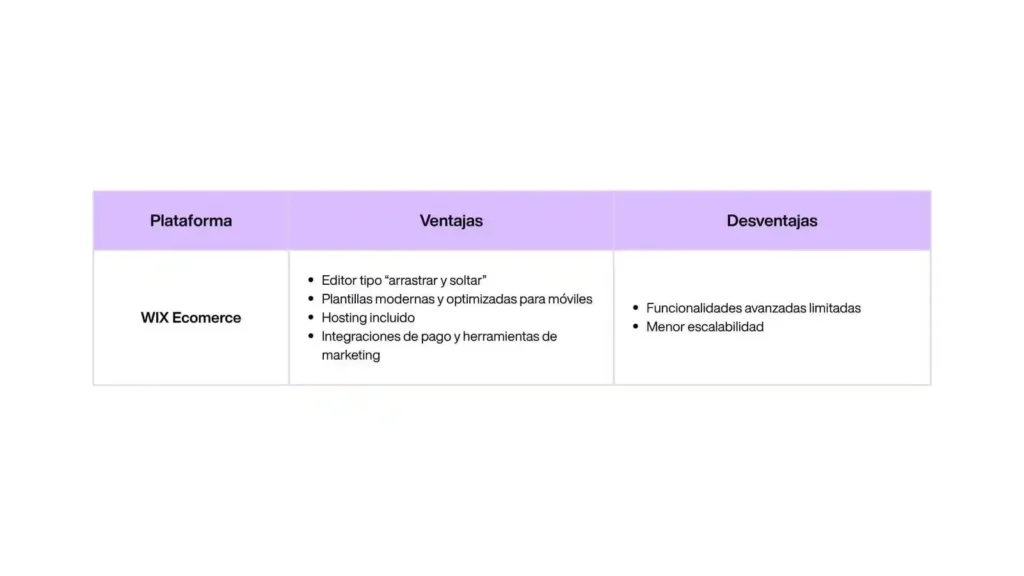
WIX Ecommerce
WIX is a visual website builder that has evolved into ecommerce, ideal for those who value design without dealing with code. Ideal for entrepreneurs, creatives, and businesses with small product catalogs.
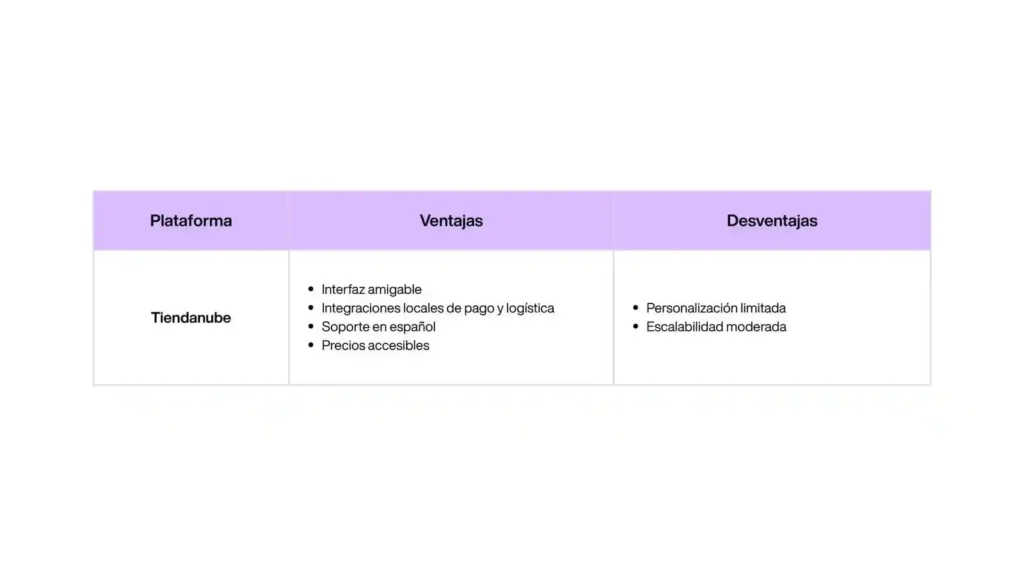
CloudStore
Tiendanube is a Latin American platform designed for entrepreneurs who sell in Mexico and other Spanish-speaking markets. Ideal for those who sell primarily in Latin America.
Magento (Adobe Commerce)
Magento is a robust platform, now part of the Adobe ecosystem, that offers maximum flexibility and technical power. Ideal for large companies or projects with high technical requirements.
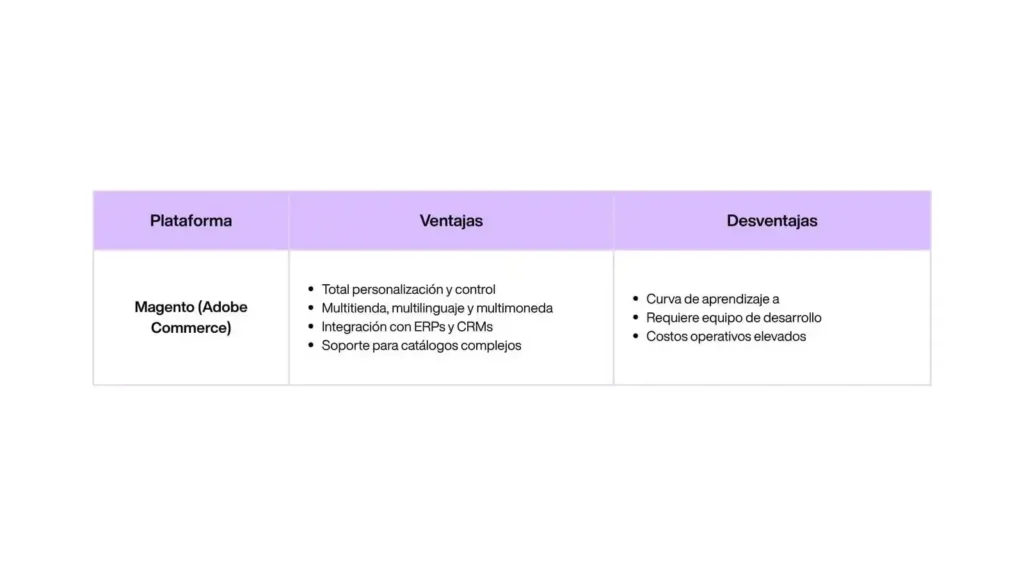
Comparison of ecommerce platforms
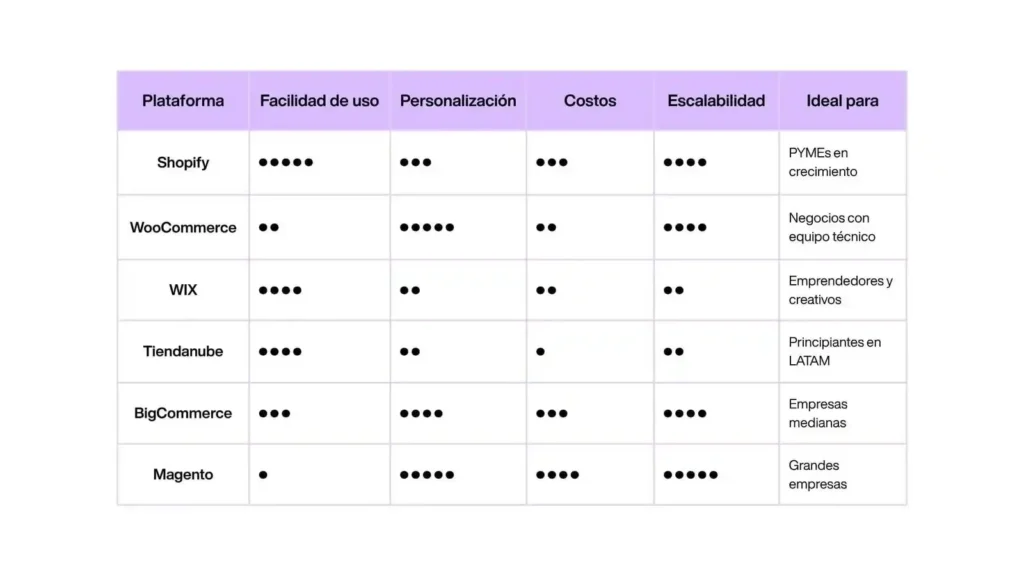
Additional recommendations
- Shopify or Tiendanube: Ideal for those with no technical experience who want to focus on selling from day one.
- WooCommerce: Perfect if you already use WordPress or want the freedom to customize at a low cost.
- Magento: Recommended if your operation requires multiple advanced features, large catalogs, or robust integrations.
- WIX: A solid option for visual businesses focused on design and speed of implementation.
If your goal is to grow in the medium to long term, make sure you choose a platform that allows you to scale without the need for costly migrations.

Design and user experience are key to converting visitors into customers
Design isn’t just about how an online store looks, but how it works. A good user experience (UX) can be the difference between a visitor who bounces in seconds and a customer who makes a purchase and returns.
In the competitive environment of ecommerce, optimizing navigation, visual design, and user interaction is fundamental to achieving conversions.
- Clean, professional, and responsive design: Your store should reflect professionalism from the first impression. A cluttered, disorganized, or unintuitive design drives customers away.
- Clear hierarchy and simple navigation: Make it easy for users to find what they’re looking for in three clicks or less. Menus should be logical, with well-defined categories and functional filters.
- Optimized product pages: Each product should have clear information, high-quality photos, and visible call-to-action buttons.
- Frictionless checkout process: A complicated checkout is one of the main causes of cart abandonment. Reduce the steps, allow guest checkout, and clearly display the total cost.
- Trust and visual credibility: The design should also convey confidence. Some elements that inspire trust:
- Verified reviews and ratings
- Visible SSL certificates
- Icons of recognized payment methods
- Clear shipping, return, and privacy policies
- AI-powered personalization: The use of artificial intelligence in e-commerce allows for the display of recommended products, dynamic content, and experiences tailored to the user based on their browsing or purchase history.
This not only improves the experience, but also increases the average cart value and customer loyalty.

SEO for ecommerce
Having a visually appealing online store isn’t enough if it’s not optimized for customers to find it. SEO for ecommerce is key to positioning your products in Google search results and attracting organic traffic with purchase intent.
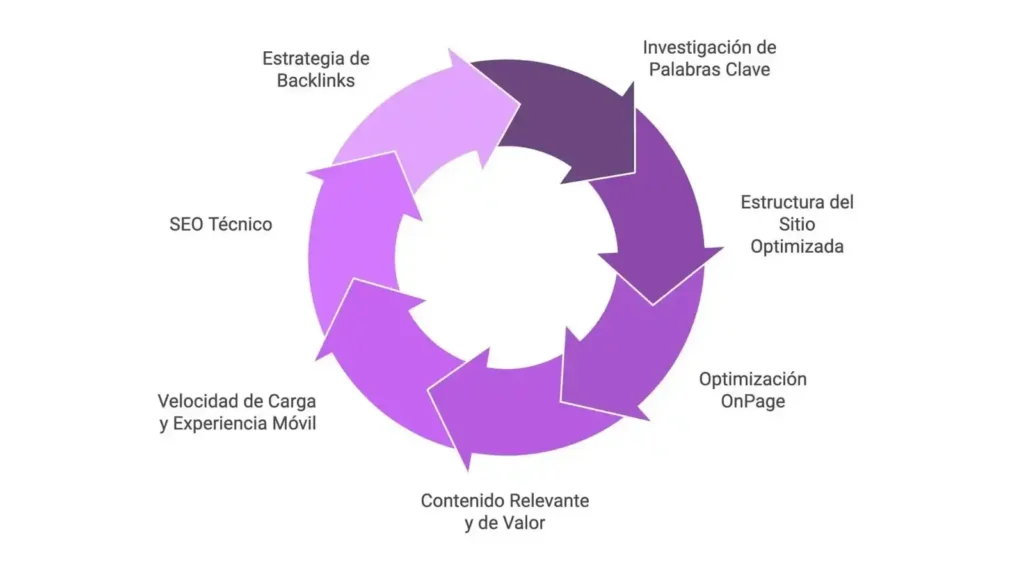
1. Keyword Research
Every e-commerce SEO strategy begins with thorough keyword research. Before writing any product or category descriptions, it’s essential to identify the terms your potential customers use when searching for similar products. Tools like Google Keyword Planner, Semrush, or Ahrefs allow you to find both product-related keywords (e.g., “running shoes”) and search intent keywords (“buy athletic shoes”). This analysis will guide your store’s content toward genuine searches with purchase intent.
2. Optimized site structure
The architecture of your ecommerce site should be designed to facilitate user navigation and indexing by search engines. Use clear categories with no more than two or three levels of depth, SEO-friendly URLs (such as /sportswear/men), active breadcrumbs to help with navigation, and make sure your sitemap.xml and robots.txt files are properly configured. A clean structure improves both user experience and search rankings.
3. OnPage Optimization
Each product and category page should be optimized with key elements to improve visibility on Google. Use descriptive H1 titles that include relevant keywords, write persuasive meta descriptions between 140 and 160 characters, use image alt text, clean and well-structured URLs, and correctly apply H2 and H3 tags to organize the content. This attention to detail improves how both Google and users understand your site.
4. Relevant and valuable content
Helpful content remains a cornerstone of SEO. Including a blog on your e-commerce site can help you attract organic traffic from users who are still in the consideration phase. Publish buying guides, product comparisons, answers to frequently asked questions, or use cases. This content not only educates but also positions your store as an authority in your niche, building trust and increasing conversion rates.
5. Loading speed and mobile experience
Google prioritizes fast, mobile-optimized websites, especially in e-commerce, where user experience directly impacts sales. Optimize images using formats like WebP or lossless compression techniques, enable lazy loading so resources load only when needed, use a CDN to deliver content faster, and remove unnecessary scripts that can slow down navigation.
6. Technical SEO
Technical SEO ensures your store is understandable to search engines and free of critical errors. Make sure you correctly implement structured data (schema.org), use canonical tags to avoid duplicate content, properly manage 301 redirects, and fix errors like 404 pages. These technical aspects help maintain your site’s health and avoid search ranking penalties.
7. Backlink strategy
Inbound links from relevant sites remain one of the most important factors for ranking on Google. Develop a strategy to acquire quality backlinks, whether through influencer collaborations, articles on specialized blogs, media mentions, or digital public relations. The more relevant links pointing to your e-commerce site, the greater your authority and visibility will be in search results.

Payment methods, security and consumer confidence
One of the biggest factors influencing conversion in an online store is trust. In markets such as Latin America, where digital fraud still raises concerns, offering security and a variety of payment methods is essential.

Payment methods you should offer
Consumers look for flexibility when it comes to paying, so it is essential to offer a variety of payment options that adapt to their needs. Using gateways such as Stripe, Conekta, Openpay, or MercadoPago allows you to centralize multiple methods into a single efficient integration. It is recommended to accept credit and debit cards such as Visa, Mastercard, or American Express, as well as bank transfers for those who prefer traditional channels. Deferred or installment payments through solutions like KueskiPay or Aplazo have also gained popularity, especially for higher-value products. In addition, integrating digital wallets such as PayPal, Apple Pay, or MercadoPago improves convenience and speed. Finally, offering cash payments via OXXO Pay or convenience stores like 7-Eleven helps reach a segment of customers that still prefers cash.

Safety as a priority
Generar confianza es clave en cualquier tienda online. Tu ecommerce debe transmitir seguridad desde el primer clic, comenzando por contar con un certificado SSL activo que asegure la navegación bajo el protocolo https. Mostrar sellos de confianza como Norton o Visa Secure ayuda a reforzar la percepción de seguridad en el usuario. También es esencial contar con una política de privacidad clara, fácilmente accesible desde cualquier parte del sitio. Además, cumplir con normativas locales como la Ley Federal de Protección de Datos Personales en Posesión de los Particulares (LFPDPPP) en México no solo es una obligación legal, sino también una señal de profesionalismo y compromiso. Una tienda segura inspira confianza, reduce el abandono del carrito y mejora considerablemente las conversiones.

Social proof that builds trust
Real reviews increase trust and help convince undecided users. It is essential to integrate them into key areas of the site, such as visible ratings and reviews directly on product pages, as well as testimonials or success stories strategically placed on the homepage or specific landing pages.
It’s also advisable to prominently display stars, ratings, and reviews to reinforce a positive perception of the product or service. Even real-time behavioral indicators, such as “12 people are viewing this product” or “5 sold today,” can generate a sense of urgency and social validation. All these signals of trust build a perception of popularity and quality, driving conversions without resorting to aggressive discounts.

4. Clear Guarantees and Policies
An online store should offer clear and easy-to-understand return, refund, shipping, and exchange policies. These policies should be visible from the main menu or in the footer so users can find them effortlessly. Avoid technical or confusing language: the more transparent you are, the more trust you build. By eliminating uncertainty about what happens if something goes wrong, you increase the likelihood that the customer will feel comfortable and complete their purchase.

Efficient logistics and automated customer service
An effective e-commerce strategy doesn’t end when the user clicks “buy.” The after-sales experience can turn a sale into a long-term relationship… or into a complaint.
- Inventory Management: A competitive store must synchronize its inventory in real time to avoid overselling or poorly managed out-of-stock products.
- Varied and Clear Shipping Options: Offering multiple delivery methods is key to satisfying different preferences. This includes standard and express shipping, real-time tracking, integration with courier services (DHL, Estafeta, Redpack, etc.), and free shipping above a certain amount.
- Omnichannel and Automated Customer Service: An online store must be available when the customer needs it. Customer service can combine traditional channels with efficient automation: live chat with automated responses, bots on WhatsApp or Messenger, a help center with a knowledge base, and email tracking with order updates.
- After-Sales and Customer Loyalty: A satisfied customer is likely to return many times. Use post-purchase thank-you emails, personalized offers based on purchase history, automated satisfaction surveys, and rewards programs to build loyalty.
- AI Automation: AI applied to e-commerce allows you to automate tasks such as product recommendations, order tracking, abandoned cart recovery via email, and customer service with dynamic chatbots. This reduces the operational workload and improves the customer experience in real time.

How artificial intelligence is transforming ecommerce
Artificial intelligence has become a key driver of innovation in e-commerce. It’s no longer a future promise; it’s a reality impacting everything from how users find products to how brands manage inventory, automate marketing, and personalize experiences. With the recent introduction of Google Search’s AI mode, the visibility of online stores will also depend on how intelligent, relevant, and useful their content and platforms are.
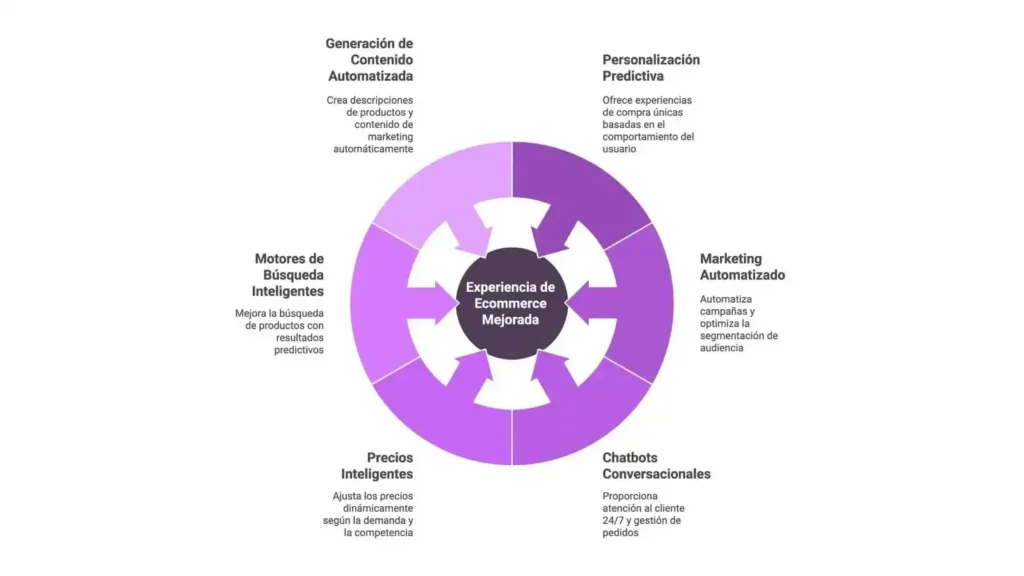
1. Real-time predictive personalization
Ecommerce platforms can now offer unique shopping experiences for each user by analyzing variables such as browsing behavior, purchase history, location, and preferences. Thanks to AI, it’s possible to instantly display suggested products, adapt promotional banners, or change the order of categories based on detected interests. This not only improves the user experience but also increases conversion rates and average order value.
2. Automated and contextual marketing
Artificial intelligence allows for the automation of campaigns that previously required hours of manual work. Today, it’s possible to send emails with personalized products, recover abandoned shopping carts with contextual messages, and run A/B tests that optimize themselves in real time. Furthermore, AI tools segment audiences by behavior or purchase intent, improving the effectiveness and return on investment of every marketing action.
3. Conversational chatbots and 24/7 support
AI-powered virtual assistants have evolved. Beyond answering basic questions, they now understand complex intentions, recommend products, manage orders, and even resolve after-sales issues. Integrating them into channels like WhatsApp or Messenger reduces the team’s workload and ensures immediate support at any time.
4. Smart Pricing and Inventory Management
AI enables dynamic pricing that adjusts in real time based on demand, user behavior, and competitor activity. Furthermore, predictive algorithms help improve inventory planning by anticipating purchasing trends, preventing overselling, and reducing losses due to obsolete or out-of-stock products.
5. Smarter Internal Search Engines
One of the main reasons for abandonment in e-commerce is the difficulty in finding products. With AI, internal search engines are now predictive, understand synonyms, correct spelling errors, and suggest more relevant results. This significantly improves the browsing experience, reduces bounce rate, and increases conversion.
6. Automated content generation
For stores with extensive catalogs, AI offers an efficient solution for automatically creating product descriptions, SEO titles, tags, and social media posts. Tools like ChatGPT, Jasper, and Copy.ai are already part of the content stack in competitive e-commerce businesses, allowing them to scale production without compromising quality or time.

Trends: automation, personalization, and omnichannel
The world of e-commerce is constantly innovating. If you have an online store or are about to launch one, understanding these trends is key to staying ahead of the curve. Brands that understand and implement these practices manage to stand out in an increasingly competitive environment, where technology, user experience, and artificial intelligence in e-commerce are the pillars of success.
1. Automation in key processes
Areas where it has an impact:
- Order and Inventory Management: Real-time synchronization across channels, automatic stock management.
- Digital Marketing: Abandoned cart emails, push notifications, dynamic ads.
- Product Updates: Automatic updates to descriptions, prices, and availability.
- Billing and Reporting: Integration with accounting and tax tools.
Recommended tools:
- Klaviyo, Zapier, Mailchimp or ActiveCampaign: marketing automation without coding.
- Shopify and WooCommerce: native integrations to automate common tasks in your store.
Automation not only reduces operating costs, it also improves the customer experience by offering fast and frictionless processes.
2. Personalization beyond the name
AI-powered personalization allows you to go far beyond the typical “Hi, John.” Today, the most successful brands use data to create hyper-relevant experiences:
- Show products based on local location or weather.
- Suggest sizes or variations based on previous purchases.
- Offer discounts based on the customer lifecycle.
- Adapt store navigation to real-time behavior.
Key technologies:
- Dynamic Yield, Nosto, or custom systems integrated into sales platforms such as Shopify
Result: higher conversion rate, longer time on site, and more repeat sales.
3. Real omnichannel strategy
Pillars of an omnichannel strategy:
- Inventory unification across physical and digital sales platforms. Integration of social networks such as Instagram Shopping, TikTok Shop, and Facebook Shops.
- Use of CRMs such as HubSpot or Salesforce to centralize information and personalization.
- Seamless experiences across all channels (website, app, marketplaces).
E-commerce in Mexico and Latin America shows a growing adoption of this strategy to gain loyalty and scale sales.
4. Video and live shopping
Video content is today’s best digital salesperson. And when you combine it with live shopping, you create an immersive, real-time experience that builds immediate trust.
- Show how to use the products.
- Conduct live demonstrations with purchase options.
- Create internal micro-influencers or brand ambassadors.
Especially useful for:
- Fashion, technology, cosmetics, and gadgets.
Tip: Platforms like YouTube Live + Shopify allow you to integrate purchases directly from the videos.
Visual content improves conversion rates and helps with SEO for ecommerce by increasing the time spent on the site.
5. Sustainability as a competitive advantage
Good practices:
- Eco-friendly shipping or recyclable packaging.
- Certifications such as Fair Trade or locally sourced products.
- Featured sections for sustainable items.
- Transparency in processes and suppliers.
Being sustainable is not a fad: it is a growing competitive advantage in modern ecommerce.

Boost your online store with an ecommerce strategy that actually converts
Your store shouldn’t just exist: it should sell, grow, and build customer loyalty.
Ready to launch your e-commerce site or improve your existing one? We’ll guide you through the entire process with technology, design, and a results-oriented strategy.
